Creator Marketing vs. Influencer Marketing: Differences, Advantages, and When to Use Each Approach
Published on
Written by
Creator marketing vs influencer marketing: what actually changes in 2026
The terms "creator marketing" and "influencer marketing" travel together in decks, briefs, and RFPs. They are not the same thing. The differences between the two change how you pick creators, how you measure results, and how the strategy holds up when you want to scale it. This guide draws the line and gives you the criteria to choose the right one for your context.
The baseline definitions
Influencer marketing. A brand partners with individuals who own a significant social audience to promote products or services to their followers. What the brand is buying is access to that audience. The content is the vehicle.
Creator marketing. An integrated system that uses digital creators of any size to produce valuable content, distribute it across channels, and measure its real impact on the business. The brand is buying three things: reusable content, the creator's narrative ability, and measurable results.
The distinction is not academic. It changes the selection criteria, the brief, the KPIs, and how you optimize the campaign week over week.
Side by side
Dimension | Influencer marketing | Creator marketing |
|---|---|---|
What you buy | Access to the audience | Content + business results |
Selection criteria | Followers, reach, engagement rate | Thematic fit, content quality, relevance |
Main KPI | Impressions, reach | Conversions, CPA, ROAS |
Creator profile | Macro and mega creators | All tiers: micro, nano, UGC creators |
Content ownership | Stays with the creator | Transferable to the brand, reusable |
Scalability | Limited, costs grow linearly | High, via platforms and creator networks |
Measurability | Hard to link to business metrics | KPIs directly tied to goals |
Role of AI | Marginal | Central: selection, analytics, optimization |
There is also an operational difference that rarely shows up in pitch decks. If a traditional influencer publishes a piece of content that misses the brand brief, your options are limited. The asset is already live. In creator marketing, you approve the content before publication. You can ask for revisions. If it is UGC, the file becomes a reusable asset you can run in paid, on your site, in your store, anywhere.
When influencer marketing is the right choice
Classic influencer marketing still works in specific situations. Three of them.
Product launches that need fast reach. If the goal is maximum brand awareness within a short window, a macro influencer generates reach that is hard to replicate any other way.
Aspirational positioning. For luxury, fashion, hospitality, and sports brands, the association with an aspirational figure builds brand equity that compounds beyond any single campaign.
Entering a new market with low brand awareness. A credible local influencer in a market where your brand is unknown works as a trust accelerator. You are borrowing someone else's familiarity while yours is still being built.
When creator marketing is the right choice
For most B2C and DTC contexts in 2026, creator marketing is the more efficient approach. Three scenarios make the gap obvious.
When the brand needs content, not just visibility. Creators produce authentic, platform-native content in days. The perceived quality is something studio production struggles to match, and the cost per asset is a fraction.
When ROI has to be measurable. Set up correctly, creator marketing answers the "how much did this campaign generate" question with hard numbers: CTR, CPA, ROAS, attributed revenue. The attribution is not perfect, but it is defensible.
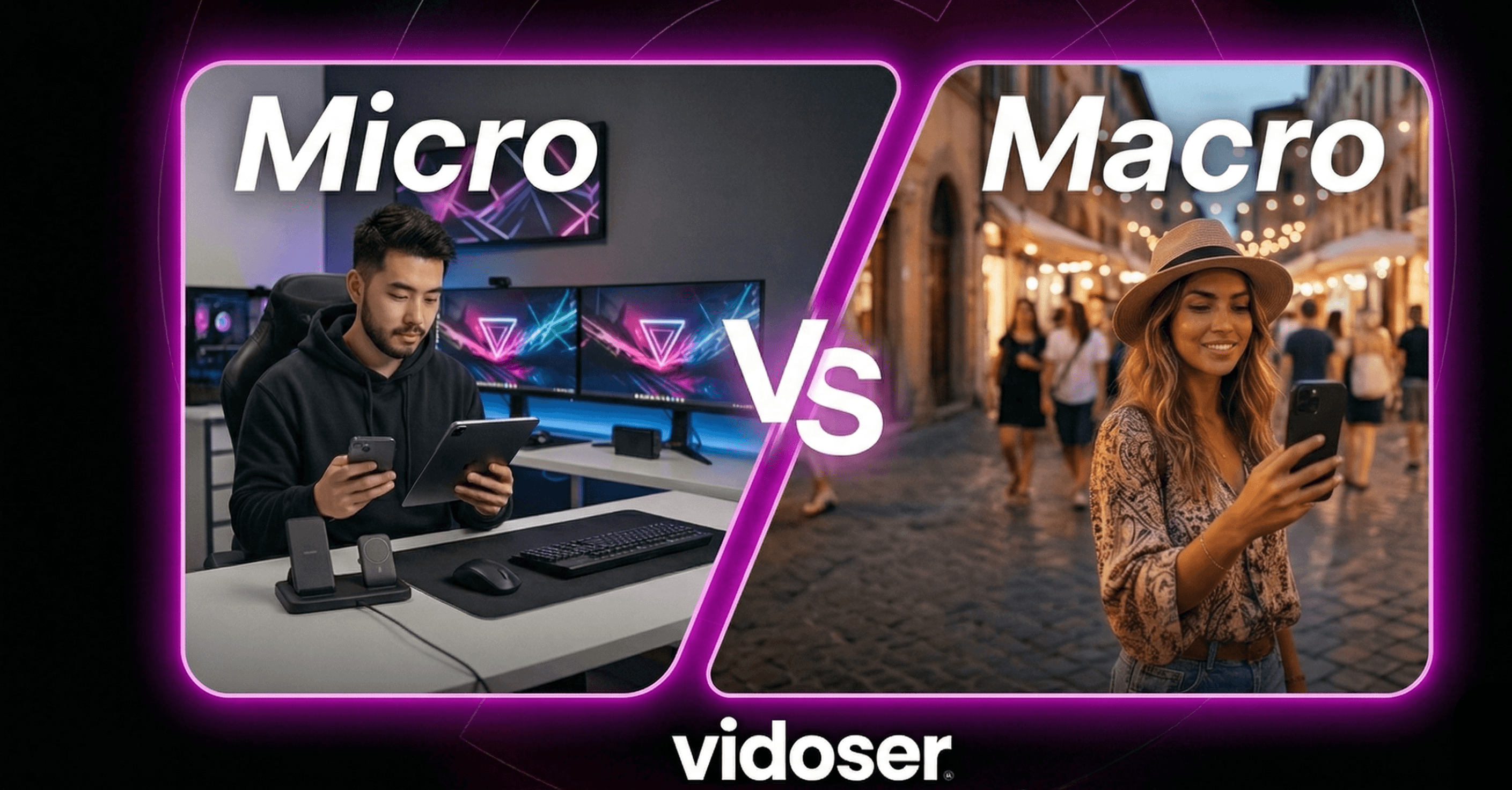
When you want to scale without costs scaling with you. Ten micro-creators often outperform one macro influencer on aggregate engagement and conversion, at a third of the total cost. You also get ten content assets, not one.
The strategy that works uses both
The brands with the most mature creator programs do not choose one or the other. They integrate the two into a single system where each tier has a clear job.
Macro influencers carry awareness.
Micro and nano creators build engagement and trust.
UGC creators produce the ad content that drives conversions.
Social commerce creators generate direct sales with measurable ROAS.
Each layer reinforces the ones next to it. The audience meets the brand through a macro influencer, hears it recommended by a micro creator they follow, sees a UGC ad while they scroll, and buys through a social commerce creator a week later.
Vidoser runs campaigns that integrate all four tiers inside one system. Talk to the team to see how this applies to your brand.
You may like